
Most public safety professionals know the value of FirstNet, the wireless broadband network dedicated to first responders. When commercial networks get congested, FirstNet’s Band 14 (operated by AT&T under contract to FirstNet) provides a critical VIP lane for emergency communications, with 24/7 Priority and Preemption service.
But what happens when that signal is blocked by the thick concrete walls of an apartment basement, or lost in the vast terrain of a remote jurisdiction? For many first responder agencies, the answer lies in a FirstNet cell booster—actually a suite of cellular telephone signal boosters offered by FirstNet and provided by AT&T and other third-party manufacturers.
Why FirstNet Signal Fails in Buildings and the Field
The FirstNet nationwide broadband network offers first responders the most extensive coverage in the United States. But even with this coverage, signals can sometimes fail to get through without the help of a cell booster. Understanding the root causes of these connectivity issues is the first step toward finding the right FirstNet cell booster solution for a public safety agency.
Identifying the right signal booster solution comes down to understanding why signals fail in the first place, and what hardware is available to fix it.
How building materials block Band 14 frequencies
Indoor wireless broadband signals can lose strength as they make their way through a
building’s structure, layout, and geography. In the simplest sense, it is akin to talking to somebody right next to you versus trying to talk to them through a wall.
Unfortunately, first responder agencies sometimes find themselves responding to locations where signals have a hard time getting in. Such locations include basements, and buildings with thick walls and other materials in the walls that degrade signal transmission. They can also include the buildings where first responder agencies are housed.
These obstructions can reduce the power of Band 14 and other wireless signals, resulting in intermittent or disrupted communications between first responders on scene and Dispatch.
Remote and rural coverage gaps for first responders
Even in the areas covered by its extensive wireless broadband network, FirstNet users can have difficulties connecting to Band 14. This is because the distance between those users and the towers they are trying to connect to may be too far to ensure reliable communications, or they can be close enough on the map, but obstructed by physical barriers that degrade signal strength.
How a Cell Booster Works
When a weak outside signal threatens first responder communications, a cell phone booster or small cell device can bridge the gap. These devices all enhance wireless coverage for first responders and those who support them, but the underlying technology differs depending on the hardware deployed.
Signal boosters vs. small cells: what is the difference
It is important to understand how boosters work compared to small cell devices.
A traditional signal booster (or cellular repeater) uses a donor antenna to capture an existing network signal, amplifies signal strength using an internal amplifier, and rebroadcasts it via server antennas. Some signal boosters do this by connecting to an external antenna and bringing the feed indoors. Others connect all of the indoor antennas into a central point to ensure consistent coverage within the entire building.
Small cell devices are technically small cellular transceivers (transmitters/receivers). Instead of capturing an outside RF signal and boosting it, they plug directly into an agency’s existing broadband internet connection to generate their own 4G LTE or 5G cell signal. This effectively places a miniature cell tower right inside the building.
What Band 14 is and why it matters for public safety
Worth repeating: Band 14 is the nationwide, high-quality spectrum set aside by the U.S. government specifically for FirstNet. It provides an exclusive “VIP lane” for public safety communications. A certified FirstNet cell booster ensures that Band 14 signals are either amplified and/or generated within the building, guaranteeing that first responder traffic remains free from commercial network congestion.
The AT&T Cell Booster Pro: What It Is and Who Qualifies
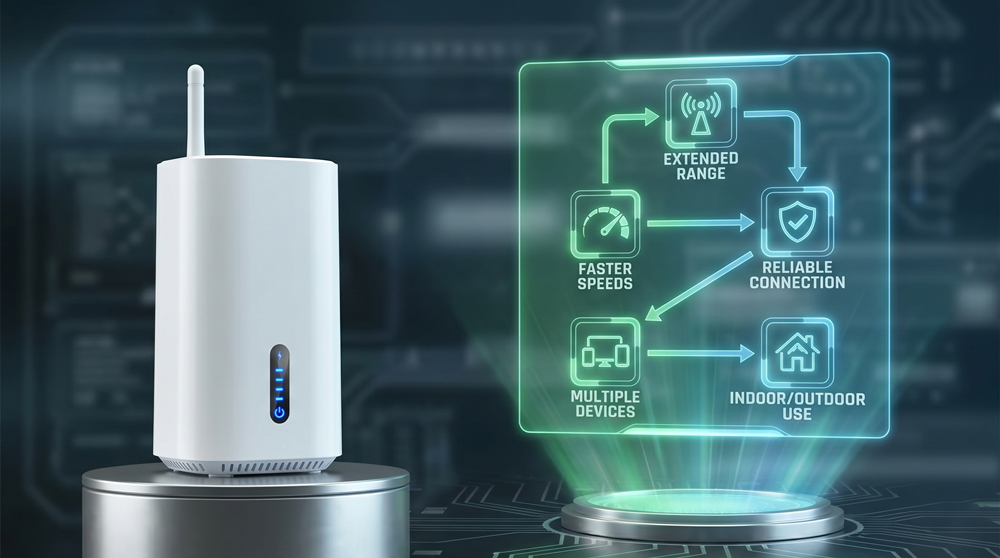
To deliver improved coverage inside public safety buildings, FirstNet offers a proprietary small cell solution known as the AT&T Cell Booster Pro. As of 2025, there are more than 11,000 of these miniature cell sites successfully deployed in first responder structures across the country.
How the AT&T Cell Booster Pro program works
The AT&T Cell Booster Pro is an enterprise-grade mini cell tower that creates a FirstNet cell signal to deliver clear calls and fast data. It provides cellular coverage for up to 15,000 square feet inside a building, supporting up to 64 simultaneous users per unit. Larger agencies can link up to six devices per location, expanding coverage up to 90,000 square feet. Collectively, these cell boosters eliminate dead zones inside buildings. They can also be managed by administrators using their own smartphones.
Eligibility requirements for primary public safety agencies
The FirstNet Authority, which operates FirstNet, provides the 4G LTE AT&T Cell Booster Pro at no cost to active, qualified FirstNet Primary Agency customers experiencing indoor coverage issues of fewer than two bars. To accept this offer, agencies must meet minimum broadband internet speeds and permanently attach a GPS antenna for E911 location locking.
Third-Party FirstNet Cell Boosters: When Agencies Need More Power
While the AT&T Cell Booster Pro is an excellent in-building solution, some environments require a different approach. Third-party options from manufacturers like Nextivity and WilsonPro provide powerful cellular repeater systems designed for larger facilities, remote areas without high-speed internet, or expansive hybrid setups.
For instance, the Nextivity CEL-FI GO RED and the Nextivity CEL-FI GO G51 are smart signal boosters (driven by IntelliBoost technology) that reduce noise and signal interference. The GO RED is particularly useful because it can connect to a FirstNet cellular signal from outside and amplify it without requiring a broadband internet connection. For truly large installations, the WilsonPro 140i Cellular Signal Booster covers up to 100,000 square feet per unit and features digital filtering to reduce interference during crisis surges.
For agencies operating at the extreme edges of the network—such as remote and rural areas—adopting FirstNet MegaRange High Power User Equipment (HPUE) delivers 1.25 watts of transmitting power to users. That’s six times more transmission power than conventional smartphones, in locations where distance and obstacles make regular transmissions unreliable.
The bottom line: Whether it’s inside or out, the right selection of signal boosters offered through FirstNet ensures that its users can be heard wherever they are, at all times.
FAQ
Is the Cell Booster Pro free for public safety agencies?
Yes, the 4G LTE version of the AT&T Cell Booster Pro is provided at no cost (both equipment and monthly service) to active, qualified FirstNet Primary Agency customers through a special investment by the FirstNet Authority Board.
Cell Booster Pro vs. third-party booster: what is the difference?
The AT&T Cell Booster Pro is a small cell device that generates its own cellular signal by plugging into an agency’s existing high-speed broadband internet connection. In contrast, a third-party booster (like a Nextivity signal booster) uses an external donor antenna to capture an existing outside cellular signal, amplifies it, and rebroadcasts it indoors without an internet connection.
Learn how a FirstNet cell booster works, when your agency needs one, and the difference between the Cell Booster Pro and third-party options.
Yes, but specific hardware is required. For ambulances, police cruisers, and fire engines, first responder agencies use specialized third-party mobile boosters or FirstNet MegaRange mobile routers (HPUE) to securely maintain broadband connectivity while on the move.
Be the first to comment on "FirstNet Cell Boosters: When Agencies Need Signal Boosting and How It Works"