
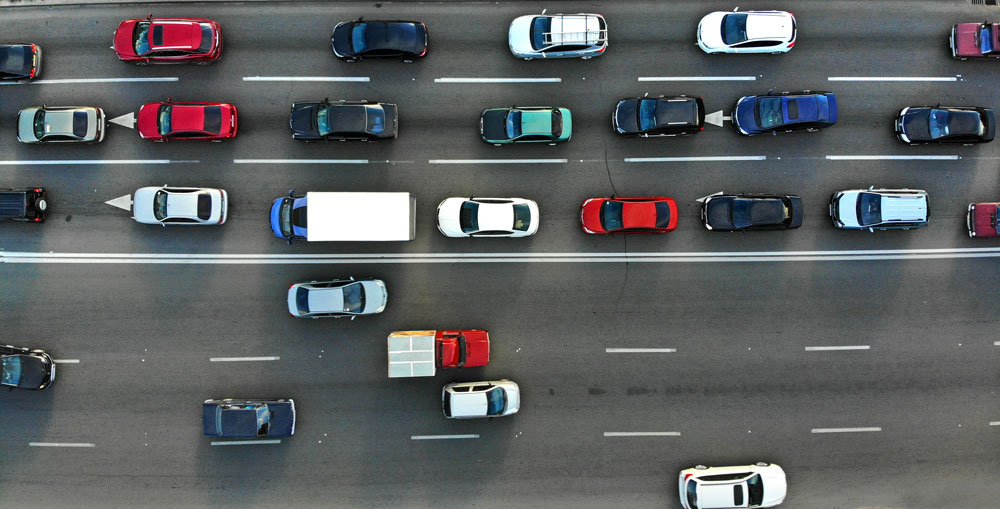
Speed is as important on a highway as it is on a cellular broadband network. When the posted speed limit is 70 mph, you want to be able to drive at that speed. When your 4G/LTE network offers average download speeds between 15-30 Mbps and average upload speeds between 10-15 Mbps, you want your data to be moving at those optimal rates. The same is true for a 5G network, where average download speeds are between 80-200 Mbps and upload speeds are between 10-20 Mbps.”
In all of these cases, it is not the stated speeds that are the issue: It is what happens when you get caught in a traffic jam. Whether on the freeway or a 4G/5G network, too many users translate into much slower speeds. On the freeway, sitting behind too many tractor-trailers at rush hour can mean crawling along at a walking pace. On a 4G/5G network, too many users can mean a snail’s pace data rate akin to being on your grandparents’ 56 kbps telephone modem — or no service at all.
For first responders, traffic jams of any kind are bad news. When it comes to their voice, video, and data communications, overloaded 4G/5G networks can result in communications blackouts and lives lost. This is why 30,000-plus public safety agencies now use FirstNet for their mission-critical communications. When all other commercial carriers are failing due to too much traffic during disasters (or the Super Bowl), FirstNet users are getting their messages through.
Why FirstNet is Different
FirstNet is a U.S. wireless broadband network reserved for public safety users. It was created by Congress following the communications failures that cost lives during 9/11. The lessons learned from the attacks on the World Trade Center and the Pentagon demanded a separate national communications system for police, fire, and EMS that would not become clogged with traffic to the point of failure during natural and manmade disasters.
“FirstNet runs on 4G/5G network facilities provided by AT&T after it won a competitive contract bidding process,” said Tracy McElvaney, VP of Product Design and Delivery at Emergent Public Safety Software. “This network, which is operated by the Congressionally-mandated FirstNet Authority, ispurpose-built to provide VIP lane service to first responders. No other network in America has been built this way, which is why they experience traffic jams that can block first responder calls.”
Two Important Differences
FirstNet is better than other wireless carriers for two important reasons. These are Band 14 and Priority/Preemption.
Band 14
“Band 14 is public safety’s ‘VIP lane’,” said McElvaney. “It is a slice of the cellular radio spectrum set aside by the federal government that is first and foremost for public safety users, especially in emergencies. No other carrier except for AT&T has access to Band 14, and iut uses it to support FirstNet.”
Priority and Preemption
Although AT&T is allowed to admit non-public safety clients to use Band 14, FirstNet users always have priority access to this spectrum. This is why their voice, video and data calls have the right to preempt non-FirstNet callers on Band 14 as needed. This is akin to having a dedicated highway lane that commercial traffic can use until overhead warning lights close the lane to everyone but authorized VIP vehicles (public safety).
“Priority and preemption means first responders always come first on FirstNet,” McElvaney said. “This means that they get the maximum 4G/5G speeds available during times of network congestion, because the public is actively removed or prevented from accessing the necessary spectrum at those critical times.”
The Result: Unmatched Performance and Reliability
Put together the advantages that only FirstNet offers to first responders, and one can see why this network offers not just better speeds to police, fire, and EMS, but the best possible speeds in all situations.
“As well, FirstNet has an explicit commitment that public safety data will not be throttled,” said McElvaney. “Throttling is what happens when carriers slow down network speeds in order to support more users on the network during high traffic situations. FirstNet never, ever does this.”
The bottom line: Thanks to its unmatched dedicated public safety architecture, FirstNet is the fastest, most reliable communications option for police, fire, and EMS nationwide. Add the fact that FirstNet has the most comprehensive coverage in the country, and no one else comes close.
FAQ
What is FirstNet?
FirstNet is the national wireless broadband network dedicated to serving first responders (police, fire, and EMS).
Why does FirstNet deliver better speeds than other public safety wireless services?
FirstNet delivers consistent performance because it grants guaranteed priority access to first responders, much like a VIP lane on a highway that excludes other vehicles.
What is Band 14?
Band 14 is a radio band that is reserved for FirstNet public safety users.
What is Priority and Preemption?
FirstNet public safety users always have priority access to Band 14, and the right to automatically preempt non-public safety traffic on that band as required

Be the first to comment on "Why FirstNet Delivers Better Data Speeds"